August 16, 2026
The r/webdev thread
Yesterday I posted
my zero-commission checkout on
r/webdev and then spent the evening answering questions. It went to 37 points, 20k viewers and 33 comments, which for a Saturday show-off post about SEPA is more attention than I expected.
Here is the whole thing, verbatim, including the two replies of mine that got downvoted. The post first, then every comment in the order it was written.
The post
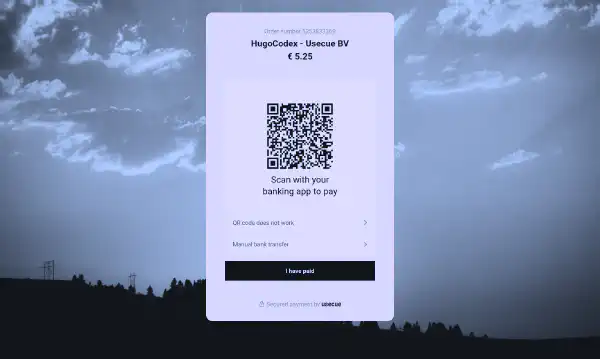
https://pos.usecue.com/p/blog/a-checkout-without-commission/
So I live in the EU and I am sick of Google, Apple and the big PSP’s earning money from our payments. They make millions because we want to buy stuff from each other. Madness! Therefore I created a modern payment method relying on SEPA Instant Payments (direct bank transfers that have no transaction fee and no middle man).
Do not think I promote this because I want users… I really don’t (and my tool is free, so it would not benefit me either). The only thing I want is for you to understand how it works. Play with it. Explore it. Then build it yourself. Integrate this into your checkout process. It is a different but simple concept that you need to see to understand. I only want to show you that it is possible.
We should not need to pay big brother to buy stuff from each other! Nobody asked me for a euro or dollar when I paid with a 100 note. Why would we accept that now? Thank god we don’t have to in the EU. Together we can cleanse the temple, just like Jezus did. Become a part of this new movement in which we make direct bank transfers the new standard.
#showofsaturday
-
u/Own_Calligrapher8508
I’m interested, how did you manage to verify the amount lands in the account?
-
u/Due_Artist_2014
That sunset background is doing a lot of heavy lifting for a payment page, makes it feel way less like you’re about to lose 5 euros to the void
The QR straight to banking app thing is clever though, cuts out the middleman entirely
-
u/me
Thanks… that 5 euro will be gone indeed… into my account. However, I am able to send it back to you without any cost. Something that was not possible before. If you had to refund you had to pay even more than for accepting the payment.
-
u/me
You can do that with an API call via PSD2 to your bank (4 updates per day) or by using Bunq, who offers free instant webhooks (beware, Bunq does not have a good rep, but you might want to use them for this). In POS transactions you get instant notifications (mostly within 2 seconds) of the payments on your phone. No need for a complex process there.
Note that we also ask for a matching hint if you do not pay via EPC QR or manual transfer.
-
u/kntx
Do you mean using open banking api? You cant just directly call the api of a bank without a aisp licence, so you would need to use a third party aggregator.
-
-
u/me
Very interesting. Just like the proposition of Bunq. These things will move the industry forwards. Holdout banks are keeping us from innovating.
-
u/me
You need a third party broker API like Ponto, which is cheap and can access multiple banks. The other option is to connect directly to the bank API’s, which require you to sign up and pay for API access per bank, which is bureaucratic and expensive… assuming you do not want to use the option Bunq offers… and assuming the ‘I have paid’ button, which tells the seller to look at his bank account, is not enough.
-
u/Bennetjs
there are providers (BanksAPI) comes to mind where you can poll the bank account for new payments. But of course it’s paid. I think you can integrate any bank API if you get access - but I don’t know the requirements (might vary per bank) and the technical details (e.g unified API)
-
u/me
Ponto is a broker that does PSD2 and can connect to all banks. It will cost you money to check and you only get updates 4 times per day, but it is relatively cheap (a few euro per month) and vibe coded in minutes. But then you can also open your bank account occasionally. Where is the harm in that? And the ‘I have paid’ button sends an email to the seller to alert him to take a look at his bank account.
This whole thing is mainly based on EPC QR. More background on this can be found here:
https://www.usecue.com/blog/what-if-epc-qr-takes-over/
-
u/Bennetjs
We had lots of issues with banking apps not pre-filling even with INST because this was not a legal requirement until very recently for most german banks so they are still stuck on the old parser for EPC.
The whole idea is sound and we worked with it, but automation is the key. If you are talking about PoS, what would you do as the seller if the customer did not set the instant transfer checkbox and it’s now a normal SEPA that takes a few hours? Would you send the customer to come back later? Would you risk the transfer not completing? What if you dont want to give bank access to your employees who are at the register while you are in the office?
For online payments I see a higher barrier for customers, they need to login to their bank and do a manual transfer. copying the IBAN + name, confirming the amount, sending.. A LOT of friction compared to the traditional online payment methods.
I would love a future where payments are done withoutlarge money-moving cooperations but I do not think the tech is quite there yet. EPC-QR is a start but it’s still so much more friction than something like Apple/Google Pay. Imagine paying your groceries like that..
-
u/me
I realize this tech is all very recent / bleeding edge. Instant SEPA transfers are mandatory since of november 2025. You can look that up. So are the new EPC QR standards.
Not giving acces to employees can be solved in many ways. This is one of them:
https://pos.usecue.com/p/blog/instant-payment-notifications-by-email/ . Using Bunq is another. Usting dedicated devices with a lock on that app is another.
The friction you are describing is the friction when completing from a mobile phone. Completing from a desktop can use EPC QR. We use free reusable payment links for mobile, especially for donations (and have been doing so succesfully for years).
Please show the EPC QR on your phone to your local grocery salesman. It has been the default in Belgium for quite some time (with Payconiq
https://pos.usecue.com/p/nl/blog/het-verhaal-van-payconiq/). Supermarkets show QR codes on their payment terminals there.
But the proof of the pudding is, as always, in the eating.
-
u/bid0u
How are you supposed to scan the QR code with your phone if you’re checking out with your phone ?
-
u/EliSka93
I’m intrigued. This kinda thing was definitely in my backlog. My plan wouldn’t even have been zero-commission, just “minimal commission to cover server hosting”, so I’ll have to dig into how you’ve solved that.
> Then I used AI to build it in no-time.
Oh well now I’m mostly worried.
-
u/me
I did not cover server hosting. Those are still costs on my side. I just build this thing to show you how to cut out the middle man. Or at least give you some ideas/direction.
> Oh well now I’m mostly worried.
I did not build it to run your production. I built it to prove a point. A multi-million dollar point.
-
u/Quentin-Code
If it isn’t made for production then you don’t prove any point at all.
-
u/me
Your read that incorrectly.
I did not build it to run YOUR production. What I mean by that is that you might want to vet/check the code before you use it in production, right? So you would at least need access to the code or you need this code to be open source, correct?
-
u/Ellsass
Why not use Wero?
-
u/me
iDEAL already takes a fixed fee on every payment (thus large percentages on small payments and tiny ones on large payments). And Wero said it will not raise prices when it takes over iDEAL for at least two years. In other words: in three years it might be just as expensive as a creditcard payment. Additionally, it will gather info on all Europeans payments. A goldmine in data. Not something you want one company to take responsibility over… right!? More info here:
https://www.usecue.com/blog/what-if-epc-qr-takes-over/
A 0.32 EUR iDEAL fee (from Mollie) on a 1.99 EUR candy bar payment is a 16% loss you are not allowed to transfer to your client/buyer. That is insane. Wero will not be better.
-
u/IrrerPolterer
Based on the docs, the payment page is entirely qurry-parameter driven… No server side validation of prices? Seems like we’re back to webshop security from the 90s… Is there Server side validation of payment, to close out the sale and I initiate notifications and shipping?
-
u/me
You hit the nail on the head. This is a complete rethink of the model, which means we are back to square one (pun intended). What if we start with the premise that we do NOT allow a middle man? What if we only allow direct transactions? Then we need the following things:
First of all we need a zero fee transaction. This can be a reusable bank payment link or an EPC QR code. In the future you might even be able to use a payto:// link, but we are not that far yet.
Secondly, we need to get notified if a payment comes in. This is generally a mobile notifcation from your banking app (within 2 seconds) which can be expanded with a notification to email app on your phone. You can also choose for a webhook if you use Bunq or you can try to rely on the claim email (see my implementation). Finally you can choose to use a broker like Ponto using the PSD2 standard to check the account, or connect directly with the bank API if you want more hassle and cost but no middle man. Many solutions to the same problem.
Finally you need to match the notifcation of the payment to the order. This part is easy in the POS as you see the notification with the amount showing up instantly during the sale. In the payment page, in case of an EPC QR or manual transfer, you can simply match on the description (no issue). When using a reusable payment link this becomes more difficult. Therefore I asked for a matching hint in my implementation (last 4 digits of the paying bank account). You can also match on time and amount, but that is (also) prone to errors. Fortunately, it is free to refund the money if the matching fails.
-
u/Ad-free-Pirate
Chill out Opus
-
u/me
I see why you would think this is AI generated (as it is long, non-offensive, structured and very detailed)… but no… I wrote this myself. This is my passion. This is my chance to convince the world we need a different direction. Sure, some parts of the applications where built with the help of AI… but AI is generally terrible when it comes to new concepts. It keeps telling me zero-fee transactions are impossible. And that I need to implement Stripe. AI cannot think outside of its own box.
-
u/Arctic_
This screen looks a lot like Mollie checkout
-
u/me
Not by accident… This is what people expect. I wanted to show that you can still give them what they expect, while getting rid of Mollie (and other PSP’s). You give users the same level of convenience, a slightly different process, but without all the cost. Not from Mollie and not from Google Pay (for POS transactions).
A lot of people will say that interest is ‘haram’ and they have good reasons: If one person takes a percentage from every transaction, the community will eventually become poorer and poorer. This is easily translated to big American companies operating in Europe. We see the rich getting richer and the poor getting poorer. This is my effort to put a stop to that.
I am not anti-American… don’t get me wrong. I think what Mollie and Adyen are doing is just as bad. I want to give the power back to the people. Peer to peer transactions… or as close as we can get to that.
-
u/cclambie
Love this. In Australia we have PayID - something similar. I was wondering if this would be possible here too.
PayId is an mobile number or email address that you pay too - it then like SEPA, an instant transfer from one bank account to another.
I wonder if the banks themselves would be upset if millions of small transactions (sub $€10) suddenly started happening between people and businesses.
As a business owner, you would need some easy way to keep track of them, the POS would have to link to the deposit some way. I assume you did that already :)
-
u/me
I would love to see a PayID version of this!
I do not think the banks mind. They are more worried about the power of PSP’s and the ECB. The banks might be on ‘our side’, if we can even talk about ‘sides’ here.
The POS uses the instant notifications from your bank to show you if the amount landed in your deposit. So that problem is solved already.
-
u/IrrerPolterer
Your documentation page reads as if you left part of the prompt response in there..
-
u/me
Which could very well be the case.
Look, I am not trying to be the next PSP. I am trying to prove a point, which is: We can do better than allowing these money exchangers in our temple. Let’s get rid of the middle man. In a POS situation the middle man is currently Google Pay and in a payment page it is the PSP. We should aspire to get as close to peer-to-peer transactions as we can. No more middle men. Not even the ECB (with the digital euro). Just plain bank to bank transfers.
Please build your own implementation. Mine is far from perfect.
-
u/madebymustafa
Honestly, this is the kind of “why are we still doing it this way?” project I love. Curious to see where it goes.
-
u/me
EPC QR is relatively new. The desktop experience of the payment page uses EPC QR and is WAY better than the mobile one, which is using reusable payment links with a variable amount. You might even say that the current desktop flow is better than the main stream processes we use right now. Please compare them. The POS is best experienced on mobile.
Please know that I have been collecting small donations in this way for the last 5 years with great success. Several clients of mine use zero-fee transactions and have been collecting thousands of euros with similar solutions.
The question is not IF payment links like this can work. They do. The question is how to embed them in your payment process. Another question is if this can work for ANY checkout. This is a demo to show you an example of a very general/main stream implementation so we can verify the latter together.
() Joost van der Schee